



Market Research Future Insights
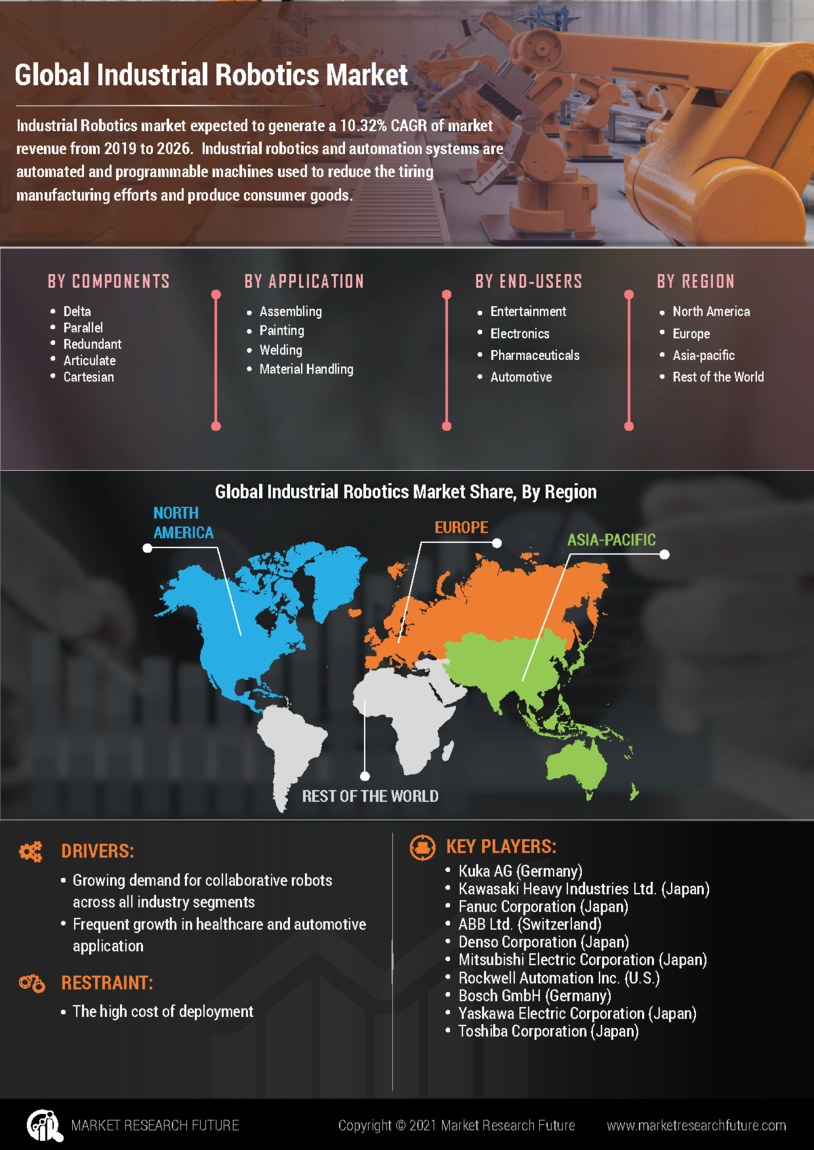
According to MRFR analysis, The Industrial Robotics market industry is projected to grow from USD 18.6 Billion in 2023 to USD 43.6 Billion by 2032, exhibiting a compound annual growth rate (CAGR) of 11.20% during the forecast period (2023 - 2032).
Industrial Robotics is mechanical machines programmed to perform tasks in manufacturing facilities. Industrial Robotics can offer better quality and consistency while ensuring maximum productivity and safety, which has boosted the demand for Industrial Robotics among major end users. The major factor driving the growth of industrial automation is increasing demand from SMEs. The major benefit Industrial Robotics offer is increased production capacity, reduced operation costs, and the ability to work for a longer duration of time.
Industries across the world are experiencing a rising adoption of Industrial Robotics. As manufacturing companies are experiencing an increasing need for higher output and reduced cost, enterprises worldwide are looking forward to adopting Industrial Robotics to enhance manufacturing efficiency and speed up the process. Current-day industrial robots can be programmed to perform many different tasks simultaneously, rapidly reducing the tasks performed by humans.
Full-scale industrial automation has enabled companies to boost precision and maintain quality and consistency in products while ensuring greater operational efficiency. The growth of industrial automation has paved the way for AI robots, IoT, and other digital technologies; companies are leveraging this new technology and automating the manufacturing process, ensuring optimal output and high production.
Request Free Sample - https://www.marketresearchfuture.com/sample_request/1933
Key Players
The key players operating in the industrial robotics market include ABB Ltd., Fanuc Corporation, KUKA AG, Yaskawa Electric Corporation, Kawasaki Heavy Industries Ltd., Denso Corporation, Nachi-Fujikoshi Corporation, Comau SpA, Mitsubishi Electric Corporation, and Universal Robots A/S.
Market Overview:
The industrial robotics market has been experiencing robust growth and is projected to continue its upward trajectory in the coming years. This growth is fueled by several factors, including the increasing adoption of automation across industries, advancements in artificial intelligence (AI) and machine learning (ML), and the need for improved operational efficiency.
Automation Revolutionizing Industries:
Automation has revolutionized industries by streamlining operations, enhancing productivity, and reducing human errors. Industrial robots have emerged as the backbone of automation, offering unmatched precision, speed, and flexibility in performing tasks. From automotive manufacturing to electronics assembly, industrial robots are being deployed across various sectors, enabling companies to optimize their production processes and meet growing consumer demands.
Technological Advancements:
The rapid advancements in AI, ML, and robotics technologies have opened new avenues for industrial automation. Cutting-edge technologies like computer vision, collaborative robots (cobots), and autonomous mobile robots (AMRs) are driving innovation in the industrial robotics market. Computer vision enables robots to perceive their environment, enhancing their ability to perform complex tasks with accuracy. Cobots are designed to work alongside human operators, enhancing productivity and ensuring worker safety. AMRs are revolutionizing material handling and logistics operations, improving efficiency and reducing labor costs.
Growing Need for Operational Efficiency:
In today's fiercely competitive business landscape, operational efficiency plays a pivotal role in determining an organization's success. Industrial robots offer unmatched operational efficiency by optimizing production processes, reducing cycle times, and minimizing errors. By automating repetitive and mundane tasks, companies can redirect human resources to more strategic roles, fostering innovation and driving growth.
Challenges and Opportunities:
While the industrial robotics market presents immense opportunities, it also comes with its own set of challenges. High initial investment costs, the need for skilled technicians to operate and maintain robots, and concerns regarding job displacement are some of the obstacles that need to be addressed. However, these challenges can be mitigated through strategic partnerships, government initiatives promoting skill development, and effective change management practices.
Browse More Details - https://www.marketresearchfuture.com/reports/industrial-robotics-market-1933
According to MRFR analysis, The Industrial Robotics market industry is projected to grow from USD 18.6 Billion in 2023 to USD 43.6 Billion by 2032, exhibiting a compound annual growth rate (CAGR) of 11.20% during the forecast period (2023 - 2032).
Industrial Robotics is mechanical machines programmed to perform tasks in manufacturing facilities. Industrial Robotics can offer better quality and consistency while ensuring maximum productivity and safety, which has boosted the demand for Industrial Robotics among major end users. The major factor driving the growth of industrial automation is increasing demand from SMEs. The major benefit Industrial Robotics offer is increased production capacity, reduced operation costs, and the ability to work for a longer duration of time.
Industries across the world are experiencing a rising adoption of Industrial Robotics. As manufacturing companies are experiencing an increasing need for higher output and reduced cost, enterprises worldwide are looking forward to adopting Industrial Robotics to enhance manufacturing efficiency and speed up the process. Current-day industrial robots can be programmed to perform many different tasks simultaneously, rapidly reducing the tasks performed by humans.
Full-scale industrial automation has enabled companies to boost precision and maintain quality and consistency in products while ensuring greater operational efficiency. The growth of industrial automation has paved the way for AI robots, IoT, and other digital technologies; companies are leveraging this new technology and automating the manufacturing process, ensuring optimal output and high production.
Request Free Sample - https://www.marketresearchfuture.com/sample_request/1933
Key Players
The key players operating in the industrial robotics market include ABB Ltd., Fanuc Corporation, KUKA AG, Yaskawa Electric Corporation, Kawasaki Heavy Industries Ltd., Denso Corporation, Nachi-Fujikoshi Corporation, Comau SpA, Mitsubishi Electric Corporation, and Universal Robots A/S.
Market Overview:
The industrial robotics market has been experiencing robust growth and is projected to continue its upward trajectory in the coming years. This growth is fueled by several factors, including the increasing adoption of automation across industries, advancements in artificial intelligence (AI) and machine learning (ML), and the need for improved operational efficiency.
Automation Revolutionizing Industries:
Automation has revolutionized industries by streamlining operations, enhancing productivity, and reducing human errors. Industrial robots have emerged as the backbone of automation, offering unmatched precision, speed, and flexibility in performing tasks. From automotive manufacturing to electronics assembly, industrial robots are being deployed across various sectors, enabling companies to optimize their production processes and meet growing consumer demands.
Technological Advancements:
The rapid advancements in AI, ML, and robotics technologies have opened new avenues for industrial automation. Cutting-edge technologies like computer vision, collaborative robots (cobots), and autonomous mobile robots (AMRs) are driving innovation in the industrial robotics market. Computer vision enables robots to perceive their environment, enhancing their ability to perform complex tasks with accuracy. Cobots are designed to work alongside human operators, enhancing productivity and ensuring worker safety. AMRs are revolutionizing material handling and logistics operations, improving efficiency and reducing labor costs.
Growing Need for Operational Efficiency:
In today's fiercely competitive business landscape, operational efficiency plays a pivotal role in determining an organization's success. Industrial robots offer unmatched operational efficiency by optimizing production processes, reducing cycle times, and minimizing errors. By automating repetitive and mundane tasks, companies can redirect human resources to more strategic roles, fostering innovation and driving growth.
Challenges and Opportunities:
While the industrial robotics market presents immense opportunities, it also comes with its own set of challenges. High initial investment costs, the need for skilled technicians to operate and maintain robots, and concerns regarding job displacement are some of the obstacles that need to be addressed. However, these challenges can be mitigated through strategic partnerships, government initiatives promoting skill development, and effective change management practices.
Browse More Details - https://www.marketresearchfuture.com/reports/industrial-robotics-market-1933
Market Research Future Insights
According to MRFR analysis, The Industrial Robotics market industry is projected to grow from USD 18.6 Billion in 2023 to USD 43.6 Billion by 2032, exhibiting a compound annual growth rate (CAGR) of 11.20% during the forecast period (2023 - 2032).
Industrial Robotics is mechanical machines programmed to perform tasks in manufacturing facilities. Industrial Robotics can offer better quality and consistency while ensuring maximum productivity and safety, which has boosted the demand for Industrial Robotics among major end users. The major factor driving the growth of industrial automation is increasing demand from SMEs. The major benefit Industrial Robotics offer is increased production capacity, reduced operation costs, and the ability to work for a longer duration of time.
Industries across the world are experiencing a rising adoption of Industrial Robotics. As manufacturing companies are experiencing an increasing need for higher output and reduced cost, enterprises worldwide are looking forward to adopting Industrial Robotics to enhance manufacturing efficiency and speed up the process. Current-day industrial robots can be programmed to perform many different tasks simultaneously, rapidly reducing the tasks performed by humans.
Full-scale industrial automation has enabled companies to boost precision and maintain quality and consistency in products while ensuring greater operational efficiency. The growth of industrial automation has paved the way for AI robots, IoT, and other digital technologies; companies are leveraging this new technology and automating the manufacturing process, ensuring optimal output and high production.
Request Free Sample - https://www.marketresearchfuture.com/sample_request/1933
Key Players
The key players operating in the industrial robotics market include ABB Ltd., Fanuc Corporation, KUKA AG, Yaskawa Electric Corporation, Kawasaki Heavy Industries Ltd., Denso Corporation, Nachi-Fujikoshi Corporation, Comau SpA, Mitsubishi Electric Corporation, and Universal Robots A/S.
Market Overview:
The industrial robotics market has been experiencing robust growth and is projected to continue its upward trajectory in the coming years. This growth is fueled by several factors, including the increasing adoption of automation across industries, advancements in artificial intelligence (AI) and machine learning (ML), and the need for improved operational efficiency.
Automation Revolutionizing Industries:
Automation has revolutionized industries by streamlining operations, enhancing productivity, and reducing human errors. Industrial robots have emerged as the backbone of automation, offering unmatched precision, speed, and flexibility in performing tasks. From automotive manufacturing to electronics assembly, industrial robots are being deployed across various sectors, enabling companies to optimize their production processes and meet growing consumer demands.
Technological Advancements:
The rapid advancements in AI, ML, and robotics technologies have opened new avenues for industrial automation. Cutting-edge technologies like computer vision, collaborative robots (cobots), and autonomous mobile robots (AMRs) are driving innovation in the industrial robotics market. Computer vision enables robots to perceive their environment, enhancing their ability to perform complex tasks with accuracy. Cobots are designed to work alongside human operators, enhancing productivity and ensuring worker safety. AMRs are revolutionizing material handling and logistics operations, improving efficiency and reducing labor costs.
Growing Need for Operational Efficiency:
In today's fiercely competitive business landscape, operational efficiency plays a pivotal role in determining an organization's success. Industrial robots offer unmatched operational efficiency by optimizing production processes, reducing cycle times, and minimizing errors. By automating repetitive and mundane tasks, companies can redirect human resources to more strategic roles, fostering innovation and driving growth.
Challenges and Opportunities:
While the industrial robotics market presents immense opportunities, it also comes with its own set of challenges. High initial investment costs, the need for skilled technicians to operate and maintain robots, and concerns regarding job displacement are some of the obstacles that need to be addressed. However, these challenges can be mitigated through strategic partnerships, government initiatives promoting skill development, and effective change management practices.
Browse More Details - https://www.marketresearchfuture.com/reports/industrial-robotics-market-1933


 Spanish
